












To mark 250 years of Franco-American relations, the Comité Colbert, the representative association for French luxury goods, has chosen to celebrate the fruitful relationship between French luxury brands and the United States with an exhibition event at The Shed in New York next May. A study shows that the France brand, or Frenchness, is still desirable across the Atlantic, despite the geopolitical tensions maintained by the Trump administration.
French luxury goods are a flourishing industry, mainly export-oriented, and the United States has been its leading market in terms of value for many years.
From Christian Dior to Coco Chanel, Pierre Frey, Yves Saint Laurent, César Ritz, and Boucheron, all the French luxury brands that are members of the committee—and their founders—have, at some point in their history, had an American adventure.
After honoring six decades of ties between France and China last year, the Comité Colbert has decided to celebrate 250 years of Franco-American relations, despite ongoing tensions with the Trump administration. The association representing French luxury goods can boast a record level of participation: 65 Houses and institutions have chosen to embrace the Hidden Treasures project, an exhibition-event at The Shed in New York from May 26 to 31.
Among them, wine and spirits companies, badly affected by customs duties on their main market, were numerous in their response.
Because while the agreement between luxury brands and the White House tenant is coming up against American protectionism, some American luxury customers continue to favor French expertise, to the point of prompting a statement confirmed by the general delegate of the Comité Colbert: yes, in luxury, Frenchness continues to sell.
American archives unveiled
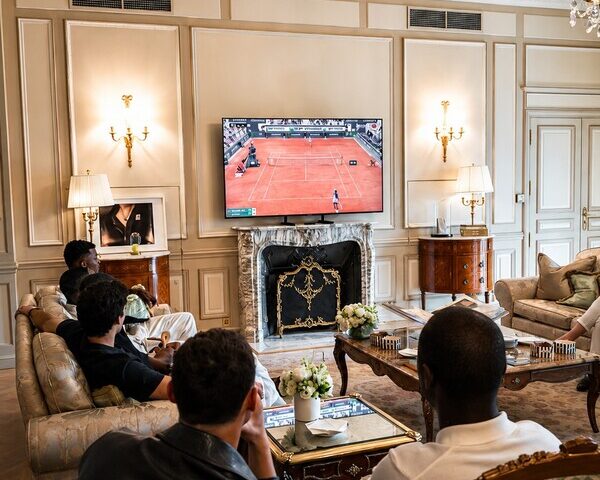
On Monday, February 9, the Comité Colbert held a press conference at the Ritz Paris. The aim was to celebrate 250 years of Franco-American relations by presenting its upcoming exhibition at The Shed in New York and a study on Americans’ perception of French luxury.
And the location was not chosen at random. Opened in 1898 by César Ritz, the establishment has long been one of the most prestigious hotels in Europe and even the world. Surrounded by his culinary partner Auguste Escoffier, the founder ensured exceptional comfort with, for the time, a few revolutionary features such as electricity on every floor, private bathrooms, and high-end service.
Over time, the luxury hotel has also become the most American of Parisian palaces, given the number of guests from the New World. César Ritz also enlisted the help of American investment bank JP Morgan to open his luxury hotel, which at the time had its global headquarters behind the neighboring Place Vendôme.
The Ritz Paris is a member of the Comité Colbert and will be part of the “Hidden Treasures” exhibition in New York in May, along with 64 other French luxury brands, such as Baccarat, Berluti, Boucheron, Cartier, Chanel, Château d’Yquem, Christian Dior Couture, Diptyque, Guy Savoy, Hermès, Lancôme, Le Lièvre Paris, Potel & Chabot, Veuve Clicquot Ponsardin, Jeanne Lanvin, Hennessy, and Yves Delorme.
Each of them will be “represented by a dedicated shipping trunk, transformed into a cabinet of curiosities.” Among the series of exceptional artifacts rooted in American culture that will be on display are Jackie Kennedy’s fuchsia pink Givenchy suit, Selmer saxophones well known to American jazz musicians, and a fresco by fabric designer and manufacturer Pierre Frey displayed in the White House. The exhibition will be divided into five chapters based on the metaphor of travel.
For the occasion, the Comité Colbert and its member Houses will take over The Shed, a cultural center located in Hudson Yards, a stone’s throw from Fifth Avenue and Madison Avenue, the world-famous luxury shopping streets. The exhibition, which is free for students and costs $35 for other visitors, will offer a souvenir book featuring an iconic piece from each participating luxury brand.
In the wake of its New York project, the Comité Colbert is also planning an American tour and is actively seeking museums and other cultural centers to cover the cities of Los Angeles, Austin (Texas), Chicago, and Miami.
This is a way for the non-profit association, founded by perfumer Jean-Jacques Guerlain to boost exports after World War II, to continue its mission of “passionately promoting this industry worldwide” by working on “a collective national narrative, not on individual Houses.” As its general delegate, Bénédicte Epinay, pointed out, the Comité Colbert “practices cultural diplomacy by talking about beauty and culture rather than divisions.”
The France brand is still desirable
The France brand, or “Frenchness,” is still popular in the United States… but not necessarily where you might expect.
While one might expect it to find its most enthusiastic supporters among the wealthiest customers or even French expatriates, Frenchness ultimately appeals particularly to “the moderate and emotionally engaged middle classes.” In their eyes, Frenchness appears as “an accessible sophistication that enriches everyday life rather than a distant aspiration.”
This is the finding of the American consulting firm The Heart Monitors, which partnered with the Comité Colbert to measure France’s current image (emotional attachment, loyalty, and purchase intent) among Americans in a turbulent geopolitical context. To do this, the firm conducted two waves of surveys (between August-September 2025 and January 2026) of 600 American consumers aged 18 to 60 who had purchased French products in the previous year.
Despite price increases linked to customs duties, 46% of consumers say their perception of French products remains unchanged. France thus remains the country whose products are most considered “worth buying” (61% favorable opinions), followed closely by Italy (57%).
These results suggest that economic pressure leads more to marginal reflection than outright rejection or a weakening of consumer desire.
The study emphasizes the need to move from showing to sharing, particularly in a climate of economic uncertainty and where quiet luxury has become the new aesthetic norm, turning away from showing off and opting for a certain individualism where it is a question of “pleasing oneself first before pleasing others.” This phenomenon explains why products in the personal rituals category (fragrances, skincare, wine) are growing.
In this context, the store must become “a place of discovery” and not an intimidating place. Moreover, as women become increasingly assertive in the United States, men have a growing need to be validated and therefore supported by brands in order to make “a worthy choice.”
A bond as old as the Declaration of Independence
The current celebrations take us back to July 4, 1776, the date of the founding of the United States of America. The inhabitants of thirteen British colonies, or “patriots,” seceded in response to increasing tax pressure.
The France of Louis XVI, aware of the weakening of its hereditary European enemy, decided to send a military contingent to lend a hand to the American insurgents. Through the Treaty of Versailles signed on February 6, 1778, France formalized its military support for Benjamin Franklin’s Americas. Nearly 10,000 French soldiers, mainly aristocratic volunteers including the famous Marquis de Lafayette, took part in the War of Independence, leading to victory at the Siege of Yorktown, which ended the conflict.
A symbol of the United States, France presented the Statue of Liberty as a gift to celebrate the centenary of American independence and the fruitful alliance between the two countries. This 46-meter-high statue, transported by ship, was born from the imagination of French sculptor Bartholdi and features a metal structure from the workshops of engineer Gustave Eiffel. It was inaugurated with great pomp and circumstance on October 28, 1886.
In the 19th century, the ultimate aspiration for the established elite and the newly wealthy from the steel, railroad, and oil industries was to import French style, whether in architecture (Beaux Arts and Second Empire styles), fashion, art, or gastronomy.
During the First World War, the memory of General Lafayette was revived to bring American troops to French soil. Military cooperation between the two nations was once again demonstrated with the Allied landings on June 6, 1944. As the big winners of the conflict, the United States became the embodiment of new modernity, and many French companies with unique expertise had an interest in counting them among their customers.
In the luxury sector, jewelers, watchmakers, and designers began to attract attention across the Atlantic between the two wars. Two major players kicked off the conquest of American customers on their home turf: Gabrielle Chanel, who arrived at Hollywood’s request in 1931, and Monsieur Christian Dior, who opened his first boutique in New York in 1948. He was the first to consolidate his presence on American soil with his licenses, perfumes, and ready-to-wear clothing.
Since then, countless fashion houses have made the leap across the Atlantic. Among them, Boucheron opened its first boutique in New York just last year.
Read also > Biologique Recherche and Carita welcomed by the Comité Colbert
Featured photo: 3D visual of the upcoming Hidden Treasures exhibition in New York next May © Comité Colbert