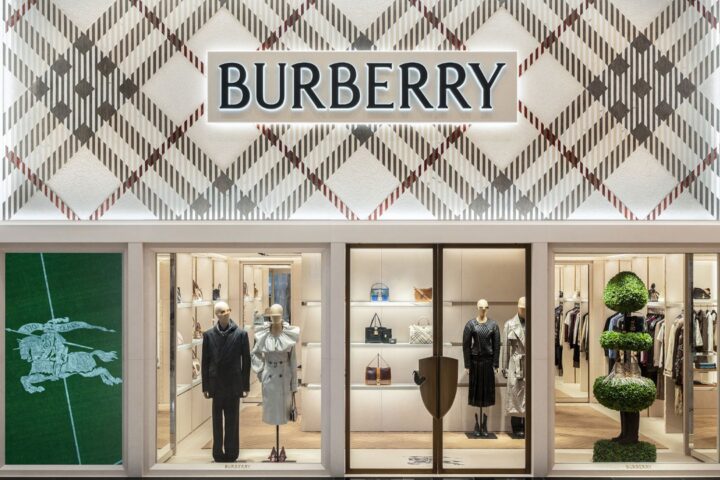














After seven quarters of decline, the British fashion house’s sales rose between July and September 2025, exceeding even forecasts. Burberry is benefiting both from its “Burberry Forward” recovery plan and the upturn in the Chinese market.
After the rain, sunny skies? Even if the weather is good for sales of Burberry’s legendary raincoats, the British fashion house can only rejoice at the upturn seen in its second quarter of 2025-26, which ended on September 27.
Having already returned to the FTSE 100, the London Stock Exchange’s flagship index, in September after a year of exclusion, the British icon continues to confirm the validity of the “Burberry Forward” recovery plan of its CEO, Joshua Schulman, who took the reins in July 2024.
Return to growth
The British luxury house has thus returned to growth after seven quarters of decline, benefiting both from its restructuring efforts and a Chinese market that has emerged from its slump.
In the second quarter of 2025, Burberry achieved a 2% increase in comparable sales, while the consensus provided by the company expected a more modest recovery (+1%).
Half-year revenue continued to decline by 3% (at constant exchange rates) to £1.03 billion ($1.36 billion). However, like-for-like retail sales growth over this period was stable, compared with a 20% decline in the previous year.
Back in the black
More good news: the British fashion house returned to profitability in the first half of the year with an adjusted operating profit of £19 million ($25.5 million), £7 million more than the £12 million ($15.7 million) expected. In the same period last year, it suffered a loss of £41 million ($53.9 million).
While Burberry’s recovery, which is still modest, will need to be confirmed in the second half of 2025-26, it is difficult not to see this as a positive outcome of the Burberry Forward plan implemented by Joshua Schulman. Seeking to “revive interest in the brand” and “promote long-term value creation,” he refocused on the House’s British DNA, its iconic raincoats and famous tartan scarves. But to restore profitability, the CEO also cut costs, notably reducing the group’s workforce by 20%.
Return to growth in China
Burberry also benefited from renewed growth in a crucial market: Greater China (comprising mainland China, Hong Kong, Macao, and Taiwan). While sales had been declining for over a year (and were still down 5% on a comparable basis in the first quarter), the Middle Kingdom posted a 3% increase in the second quarter.
“We are starting to see customers returning to the brands they love,” Joshua Schulman said in a statement.
Other regions posted similar growth, with +1% in EMEIA (Europe, Middle East, India, and Africa), +3% in the Americas, and Asia-Pacific (excluding Greater China) remaining stable.
Caution
While the luxury market remains challenging, this welcome but still tentative improvement is prompting Burberry to remain cautious. “We are only in the early stages of our recovery, and the macroeconomic environment remains uncertain,” the group said in a statement.
Its “priority this year is therefore to capitalize on the initial progress made to rekindle desire for the brand, which is essential for revenue growth,” the British fashion house continued. It also expects “the impact of its initiatives to amplify over the course of the year.”
“We will continue to improve our margins by focusing on simplification, productivity, and cash flow. We remain confident in our ability to position the company for a return to sustainable and profitable growth,” it said.
When the results were published on the morning of November 13, Burberry’s share price was up +7.9% shortly before noon. Over the past year, it has risen 79.9%.
Read also > London Stock Exchange: Burberry rejoins the FTSE 100
Featured photo: © Burberry