









After several years of rumors surrounding a first Louis Vuitton hotel on the Champs-Élysées, LVMH has finally clarified its position. Bernard Arnault’s group is abandoning plans to develop a hotel business under the Louis Vuitton brand and is refocusing its Paris project on a vast retail and experiential space. This decision comes as the luxury sector is experiencing a slowdown.
Louis Vuitton will not become a hotel brand
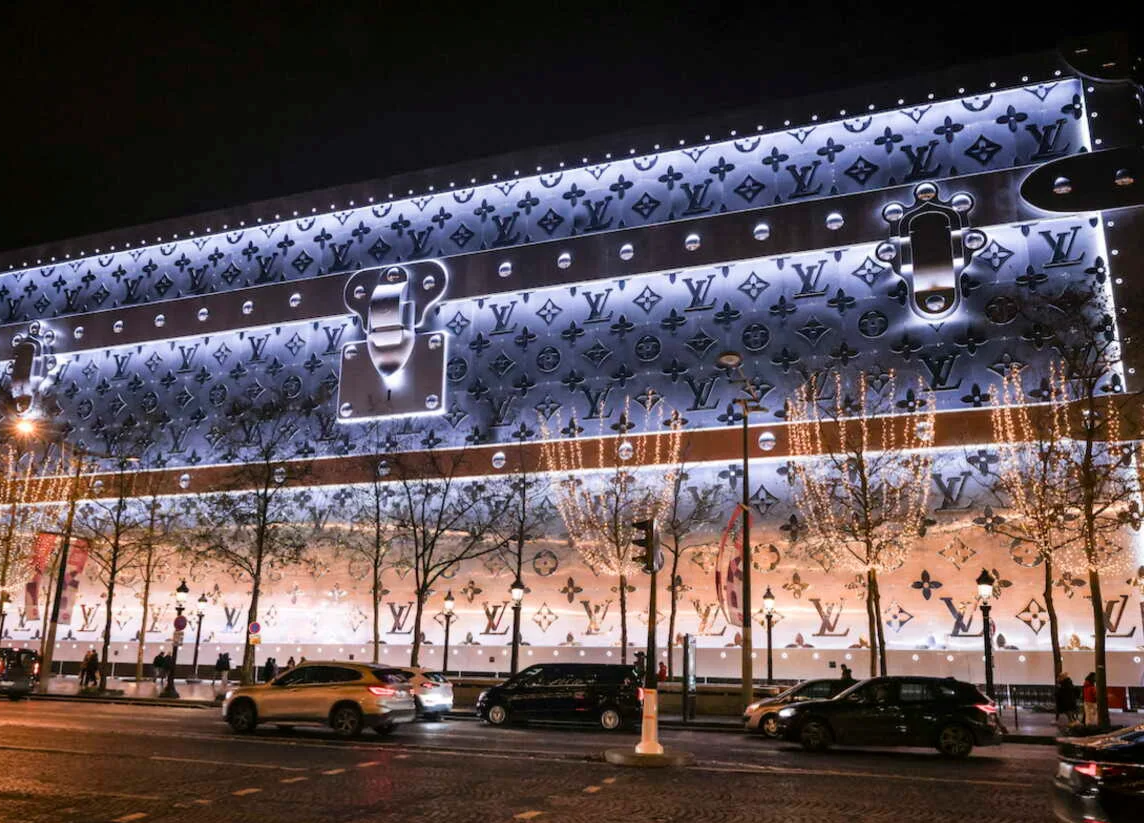
For several years, the construction site at 103-111 Avenue des Champs-Élysées, hidden behind a spectacular Louis Vuitton trunk, fueled speculation about the opening of the brand’s first hotel. The administrative permits granted in 2023 had further reinforced this assumption.
But during the presentation of LVMH’s annual results, Bernard Arnault put an end to the speculation. The group’s chairman and CEO stated that Louis Vuitton would not be entering the hotel industry under its own brand, believing that the House should remain focused on its core business—leather goods and the craftsmanship that has made it successful. The group is, however, continuing its investments in hospitality through its specialized brands such as Cheval Blanc and Belmond.
A new temple of the Louis Vuitton experience
The abandonment of the hotel idea does not, however, mean a change in ambition for this iconic address. The building will house a massive Louis Vuitton flagship designed as a destination in its own right.
The project includes retail spaces, private lounges, exhibitions, dining concepts, and various immersive experiences designed to deepen the relationship between the brand and its customers. The goal is to transform the building into a vibrant hub where shopping, culture, gastronomy, and premium services complement one another—without offering hotel accommodations under the Louis Vuitton brand.
Luxury facing a more complex environment
This clarification comes amid a less favorable climate for major luxury groups. After several years of exceptional growth, the market is facing a slowdown in demand, particularly in China, while high-end consumers are becoming more cautious in their purchases.
LVMH’s latest results have, in fact, disappointed financial markets, with the group citing an environment that remains uncertain despite the strength of its core brands. This situation is driving industry players to focus their investments on activities offering the greatest potential for profitability and differentiation.
Focusing on the experience without straying from its DNA
By abandoning plans to turn Louis Vuitton into a hotel brand, LVMH is prioritizing a strategy of consistency. The group continues to expand its offerings in the luxury hotel sector through dedicated brands, while transforming Louis Vuitton boutiques into true experiential destinations.
The future complex on the Champs-Élysées illustrates this direction: rather than a luxury hotel, it aims to become one of the brand’s global showcases, capable of attracting an international clientele through an immersive experience blending retail, culture, and lifestyle. This is LVMH’s way of responding to evolving consumer expectations while preserving the identity of its flagship brand in a luxury market that has become increasingly demanding.
Read also > Belmond transforms the Venice Simplon-Orient Express journey into a literary odyssey
Photo à la Une : © Jack Tribeca