









Just five years ago, treating yourself to a luxury classic was a rite of passage. Today, with price increases sometimes exceeding 20% a year on certain iconic bags, making a purchase has become a very deliberate decision. Faced with these soaring prices, stepping into a Toteme, Sézane, or Polène store offers a real sense of relief: the relief of treating yourself to a high-quality piece without feeling like you’re paying solely for the prestige of a major brand.
Customers’ choices now depend on their perception of value. The findings of the latest Accenture study reveal a shift: 37% of customers* believe that value for money is declining among major luxury houses. Luxury is losing its magic: 50% of customers* feel that these brands have become profit-driven companies rather than creators of dreams.
As brand loyalty wanes—to the point that 54% of the wealthiest customers (VIC)* are turning to the secondhand market—a new wave of independent brands is emerging. These challengers are redefining the contours of a desirable, responsive, and more transparent luxury.
Luxury is rising, but becoming more exclusive
The post-Covid era has transformed the market. Between 2021 and 2023, the sector’s growth was driven by a highly aggressive pricing strategy. The example of the Chanel Timeless bag is striking: its price jumped by more than 70% between 2019 and 2023***. Luxury houses have raised their prices to target the wealthiest customers. By way of comparison, a pair of pants at Dior now costs around 1,900 euros, compared to about 900 euros before this surge, according to an analysis of retail prices for the 2021–2025 period.
This shift toward the “very high end” has sent shockwaves through the industry: in just two years, the luxury sector has lost 80 million customers**, primarily from the so-called “aspirational” customer base. Faced with inflation, these customers have been forced to turn away from historic fashion houses. Since 2024, the sector has been changing: loyalty is no longer a given; it must be earned every day.
The Rise of Asian Competition: Bernard Arnault’s Assessment
In this changing landscape, China occupies a strategic position. Bernard Arnault has repeatedly emphasized that China has become a central driver of the global luxury market, representing a vital share of LVMH’s growth, as he noted during LVMH’s annual results conference and as corroborated by Bloomberg.
However, this market, which was once the strength of the historic groups, is also becoming a breeding ground for credible new players. The rise of premium Chinese brands such as Songmont, Icicle, and Ms MIN shows that competition will no longer come solely from the West. These brands no longer seek to imitate Europe; they are building their own identity by blending local craftsmanship with contemporary codes. They are capturing a local clientele that, according to Accenture, places increasing importance on affirming its cultural heritage.
A New Generation of Independent Houses
These brands possess a major strength: they are independent. They master the codes of luxury without bearing its historical baggage.
Toteme is a prime example. Founded in 2014, the Swedish brand reached 180 million euros in revenue in 2024* according to the newspaper Le Monde. By opening a boutique on Rue du Faubourg-Saint-Honoré, it offers prices that reflect the luxury of fifteen years ago: 300 euros for pants, 1,200 euros for a coat.
On a more exclusive note, the American brand The Row perfectly embodies this shift. By focusing on top-tier quality without logos and absolute discretion, it is perceived by many customers as a more authentic alternative to century-old fashion houses. This agility is vital: 83% of luxury executives* admit that their customers are evolving faster than their ability to adapt their own companies.
Experience, the new differentiator
Human connection has become the central focus. 76% of customers* say that staff expertise and hospitality directly influence their brand loyalty, as noted by Accenture in its Luxe Eternal 2026 study.
This is where new players, such as Polène, are gaining ground. Guillaume Etancelin, the brand’s training manager, told me in an interview: “We don’t present ourselves as a luxury brand, but as a French leather goods house. We employ artisanal craftsmanship but with a different design process. ”
The strategy is to offer the same techniques as those of historic Houses, but with more direct management. The welcome is carefully curated starting from the outside of the store, because, as Guillaume explains: “The experience begins in the queue.” To support this level of service, Polène has hired nearly 200 people at its headquarters in one year* to build a solid organization.
A new division of roles
Historic Houses retain immense financial power. But they are no longer alone. Swedish, Chinese, French, and American brands are capturing a growing share of the spotlight. They are filling the void left by the price hikes imposed by the giants.
The challenge for these century-old houses is to remain relevant in a world where legitimacy no longer comes solely from the past, but also from the ability to offer a genuine experience and a competitive price.
Read more > Chinese jeweler Chow Tai Fook sets its sights on the French market
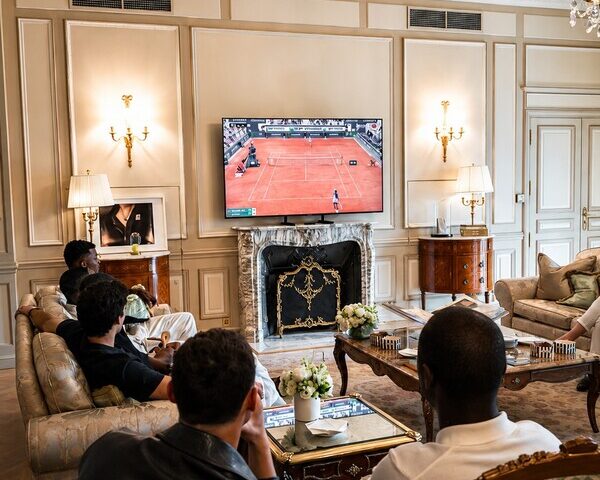
Featured photo: Polène Taikoo Li Sanlitun flagship store, Beijing/Songmont/ Toteme Paris flagship store