



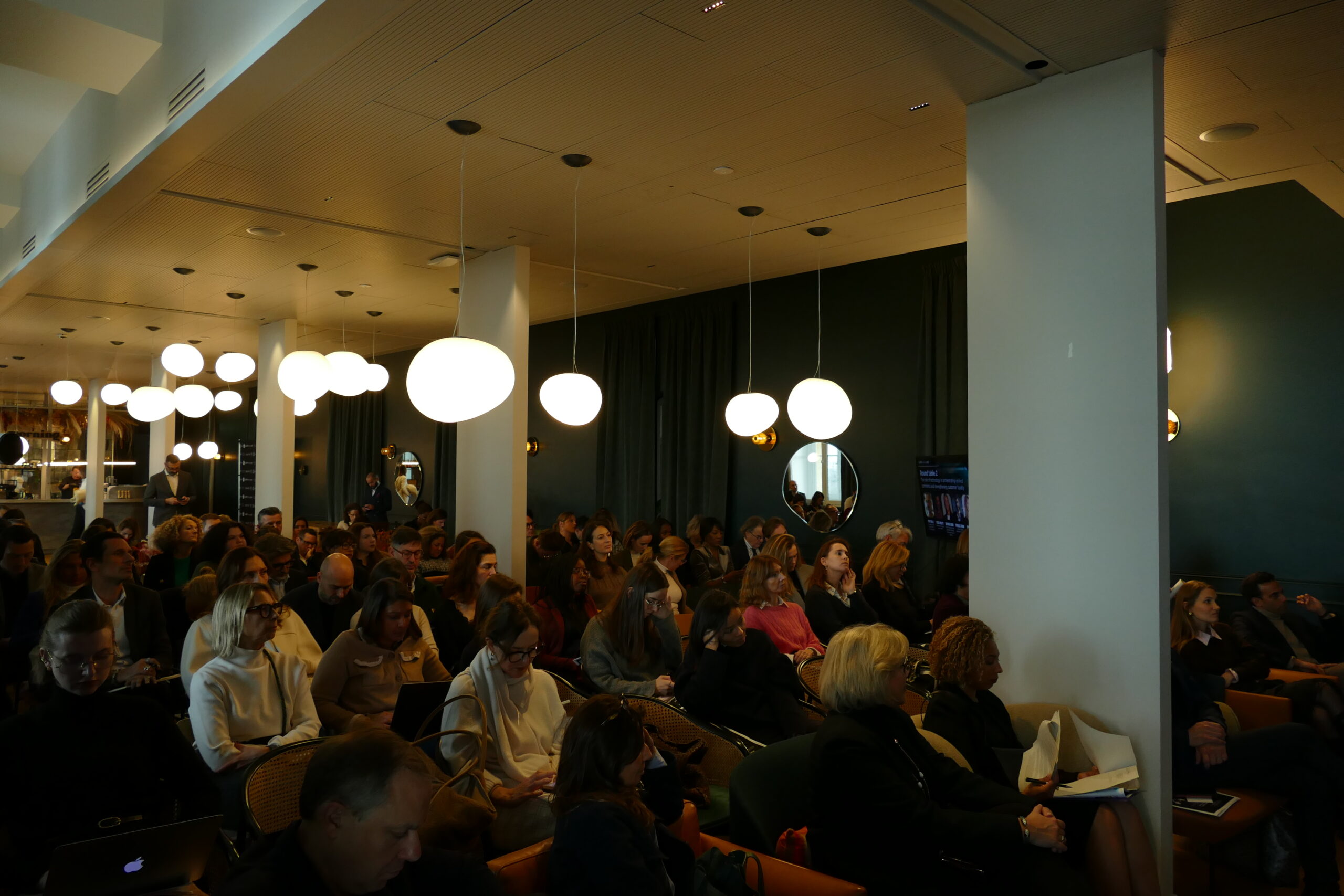








Luxury industry players gathered in Paris on November 18 for the LUXperience(s) event, which provided an opportunity to take stock of the challenges of customer experience in the luxury sector in the digital age, with its information overload and the rise of AI. Here’s a look back at the morning’s proceedings, which featured presentations by several specialists.
A packed room. On Tuesday, November 18, more than a hundred people gathered at the Morning Concorde (Paris 8th arrondissement) to attend LUXperience(s). Thanks to an exclusive Ifop Group study conducted in collaboration with Luxus Plus and presentations by key executives, this series of discussions in English examined the issues and challenges related to the customer experience in the luxury sector, while profiling consumers and recontextualizing this data in the era of artificial intelligence.
All of the morning’s round tables were moderated by Maud Lagarde, senior advisor for digital customer experience in the luxury sector and former LVMH employee, while Claire Domergue, founder and editor-in-chief of Luxus Plus, delivered the keynote speeches.
Identifying specific profiles
We need to “redefine luxury through experience,” said Claire Domergue, editor-in-chief of Luxus Plus magazine, during the opening speech at LUXperience(s). Above all, a brand must know its target audience, and the study presented by Rémy Oudghiri, sociologist and CEO of Sociovision (Ifop group), provided insight into the profile and expectations of luxury consumers in 2025.
By analyzing the responses of 4,535 customers around the world, Ifop was able to determine the five main motivations that drive people toward luxury, including long-term investment and the notion of reward. To go further and understand how customers think, the polling company also identified five luxury consumer profiles, with two dominant types: hedonists and creatives, who represent 23% and 22% of respondents, respectively.
Training tomorrow’s talent in these concepts and trend analysis may be essential to shaping the future of the industry. This is where specialized training institutions come in, such as the ISG Luxury Program.
With nine campuses, including three internationally, the school aims to raise awareness among its students of changes in consumption in the sector and the importance of excellence, said Véronique Lepinay, director of institutional communication and international experience at ISG. This is all the more important given that Generation Z, born between the late 1990s and early 2010s, is “highly connected and has a very different approach to luxury” compared to their elders.
Preserving emotion in the digital age
It is undeniable that each generation consumes differently, but common pillars, such as a commitment to product excellence and human interaction, remain. According to Ifop, 54% of people favor the product, while 46% value the physical experience and connection with brands. This is a trend that is becoming even more pronounced among Gen Z.
It is therefore necessary to appeal to these young people, “who often discover a brand on social media,” said Professor Estelle Dinh, CEO of Attixs Global Collection S.A., during the round table discussion entitled “From experience to brand excellence: how are practices evolving?” Today, “the brand is a universe (…), and Gen Z doesn’t just want to gather information, it wants to participate and influence,” she insisted.
Faced with this challenge, it is “interesting for a brand to take its existing DNA and reinvent it in line with modern luxury,” according to Bertrand Petyt, European director of SKAL International and hotel operations at Orient Express Sailing Yachts. It remains to be seen how the sector will combine this constraint with the emergence of artificial intelligence, which is used by 67% of consumers, according to the Ifop study.
Moreover, according to the polling company, this tool will be at the heart of the luxury experience of tomorrow. But in what context? Artificial intelligence “is not an end in itself, because luxury is above all an experience,” insisted Stanislas Vignon, Head of Digital Intelligence at LVMH, during the second round table discussion of the morning, entitled “The role of technology in orchestrating unified commerce and strengthening customer loyalty.”
This view was shared by Tony Pinville, an expert in this technology and a pioneer in its use to predict trends and needs in fashion and luxury. With Heuritech, the company he co-founded in 2013, he analyzes social media data to measure the performance of key pieces from fashion brands and luxury houses and thus refine the marketing mix. ” Artificial intelligence can therefore help us align ourselves with individuals by pushing the right product at the right time,” he explained. It is also used to optimize production in an era when the textile sector is responsible for 4 to 8% of global greenhouse gas emissions, according to a report by Ademe (the French Environment and Energy Management Agency) .
Experience in practice
So how do brands differentiate themselves in the field? At Louis Vuitton, for example, artificial intelligence is not yet predominant. “The information we have about our customers’ attitudes is still based on physical stores,” said Capucine Jourde, strategic development project manager for customer experience at the company. What matters, “is humanization, because it provokes emotion and strengthens the loyalty of our buyers, who need to know that they are part of a circle.”
The same is true in jewelry. For Gemmyo, “the customer experience revolves around conversation rather than consumption,” explained Caroline Pannhasiri, the brand’s marketing director. Gone are the days of in-store stock; customers are welcomed as if they were at home thanks to boutiques decorated in warm, soft tones and noble materials such as wood. These are ideas shared by the luxury decorators at Ateliers Berger, for whom “art is a powerful tool for creating emotion,” according to founder Ariane Berger.
For its part, Rova Caviar focuses on the rarity of the product. Since 2009, Delphyne Dabezies and her husband have been farming sturgeon in Madagascar. In order to offer a high-quality product, the farm selects only pure species, including the Persicus, which had been declared extinct. Today, the couple invites Michelin-starred chefs to visit the farm, as well as VIP clients, to discover the exceptional dishes and the value chain that is 100% managed by the company.
At the end of a morning organized around two large round tables, all these professionals agreed that consumer habits are changing profoundly. This phenomenon is driven by Generation Z, which is increasingly turning away from objects in favor of experiential luxury. The industry must therefore adapt by creating lasting emotional value, further personalizing its services, and maintaining the excellence of its expertise. As Pascal Malotti, Consulting Director at Valtech France, summed it up, “Luxury is not there to disrupt people, it’s more a question of heritage.”
Featured photo: © Luxus Plus