






On November 22, 1900, the manufacturer Daimler-Motoren-Gesellschaft completed construction of the Mercedes 35 hp, a vehicle that would mark the birth of the modern automobile. This car laid the foundations for a brand that is still going strong 125 years later.
Thanks to the audacity of Emil Jellinek and the genius of Wilhelm Maybach, the very first Mercedes was born on November 22, 1900, completed at the DMG factory in Cannstatt. And it was not just another vehicle : it embodied an entirely new vision of mobility.
Commissioned by Jellinek, a businessman and car enthusiast, the Mercedes 35 hp was designed to meet his requirements for a vehicle that was both powerful and refined. Jellinek, an influential customer of DMG, placed a massive order for 72 vehicles in 1900, which he intended for wealthy customers across Europe.
It was following a tragic accident during a race that Jellinek demanded a more stable model : in 1900, a driver he had hired to drive a 23 hp Phoenix was killed during the La Turbie hill climb. In tribute to his daughter Mercédès, he named the project Daimler-Mercedes, soon shortened to Mercedes, which became the official name of DMG automobiles.
A technical revolution
Engineer Wilhelm Maybach, supported by his team, took up the challenge : to design a car that was fundamentally different from the motorized carriages of the time. What he proposed was daring : the chassis was longer and wider, with an extremely low center of gravity, offering unprecedented stability and driving safety.
Mechanically, the Mercedes 35 hp was even more innovative : it was equipped with a high-performance 5.9-liter four-cylinder engine, developing 25.7 kilowatts of power, or 35 horsepower, at 950 revolutions per minute.
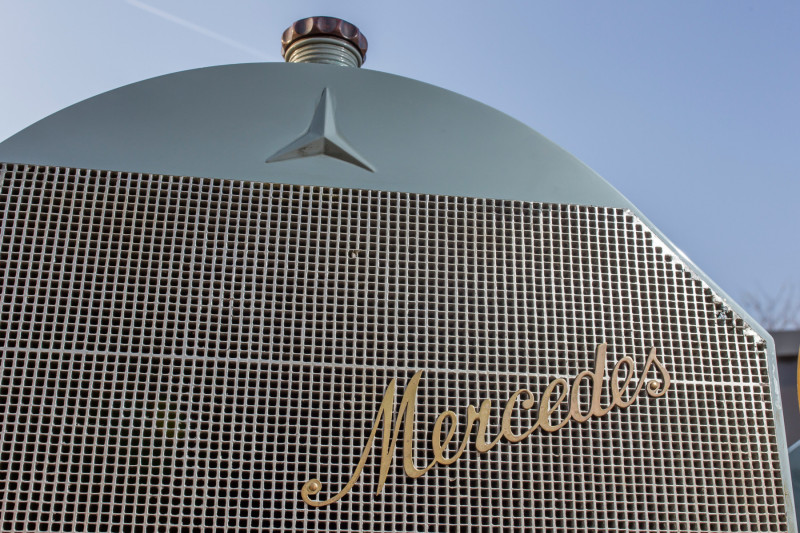
The most iconic feature was undoubtedly the honeycomb radiator invented by Maybach, which provided highly efficient cooling. Initially purely functional, this grille later became a symbol of the Mercedes brand, featured in modern grilles such as the Mercedes-GLC.
Other technical advances included a sloping steering column and a foot-operated clutch gearbox, ergonomic choices that already reflected a thorough consideration of driver comfort.
Before delivery, the Mercedes 35 hp underwent rigorous testing for several weeks. After this “running-in” phase, the first model was shipped to Jellinek in Nice on December 22, 1900.
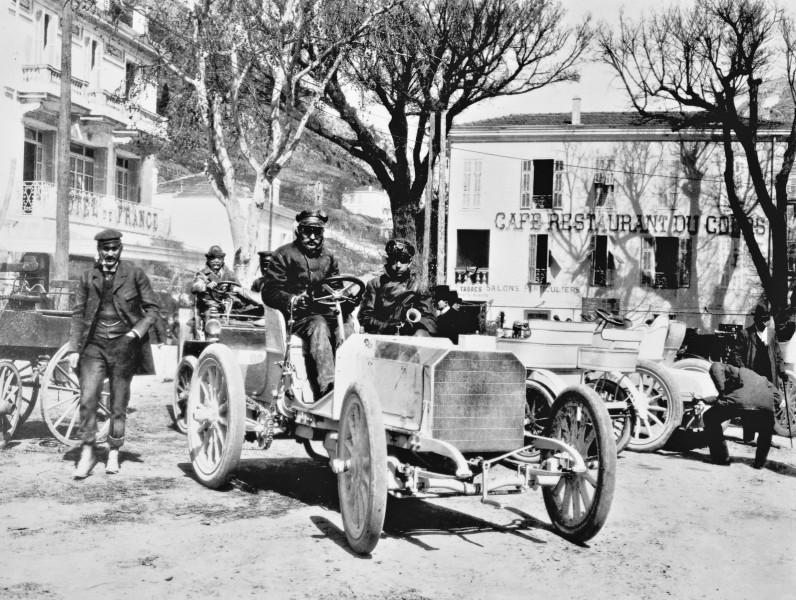
A few months later, in March 1901, during Nice’s “Race Week,” Jellinek entered several of his Mercedes cars. The model literally dominated the competitions, winning the Nice-Salon-Nice race (392 km) and the La Turbie hill climb. This sporting success highlighted the car’s technical superiority and built the “Mercedes” reputation : the secretary general of the Automobile Club de France declared that the “Mercedes era” had begun.
After the 35 hp : expansion and foundations
The triumph of the Mercedes 35 hp quickly launched a first generation of models. In 1901, DMG presented two versions : the Mercedes 12/16 hp and the Mercedes 8/11 hp, adapted to a wider range of uses.
Then, in 1902, the Mercedes-Simplex range was launched, named after its relative simplicity of operation, a concept that was quite revolutionary for the time.
That same year, another strategic step was taken : DMG purchased a 185,000 m² plot of land in Untertürkheim. This is where the main Mercedes-Benz factory is located today.
Throughout the 20th century, the manufacturer underwent profound changes. On June 28, 1926, Daimler-Motoren-Gesellschaft merged with Benz & Cie to form Daimler-Benz AG, and the Mercedes-Benz brand was officially born.
Over the following decades, the company expanded its activities far beyond passenger cars : it became involved in aeronautics, producing engines for aircraft, tanks, and submarines, particularly during World War II.
More recently, a strategic shift took place : on February 1, 2022, Daimler AG changed its name to Mercedes-Benz Group AG, marking a major reorganization. The new entity refocused on premium passenger cars and commercial vehicles, while maintaining a strong focus on electric mobility and digital services.
A quarter of a century later, the Mercedes 35 hp retains a central place in automotive history. Not only did it inspire subsequent models, but its design left an indelible mark.
Read also > A third quarter in the red for Aston Martin and Mercedes-Benz
Featured photo : © Mercedes-Benz