






Created in the 18th century in the workshops of Oberkampf in Jouy-en-Josas, Toile de Jouy has survived the centuries without losing its soul. With its bucolic and narrative scenes, it embodies French elegance and has always fueled the imagination of an idealized, almost enchanted life. From interior design to fashion runways, cinema to contemporary arts, this heritage print has reinvented itself in every field, without ever denying its DNA, to the point of becoming permanently embedded in the collective unconscious.
From the printed fabric to the birth of toile de Jouy
“Toile de Jouy does more than just decorate: it tells a story. A true visual narrative, it embellishes interiors while reflecting a culture and taste conducive to daydreaming and storytelling. “ emphasizes Alain Montandon, professor of comparative literature at the University of Clermont Ferrand, in his book Étoffes & littérature.
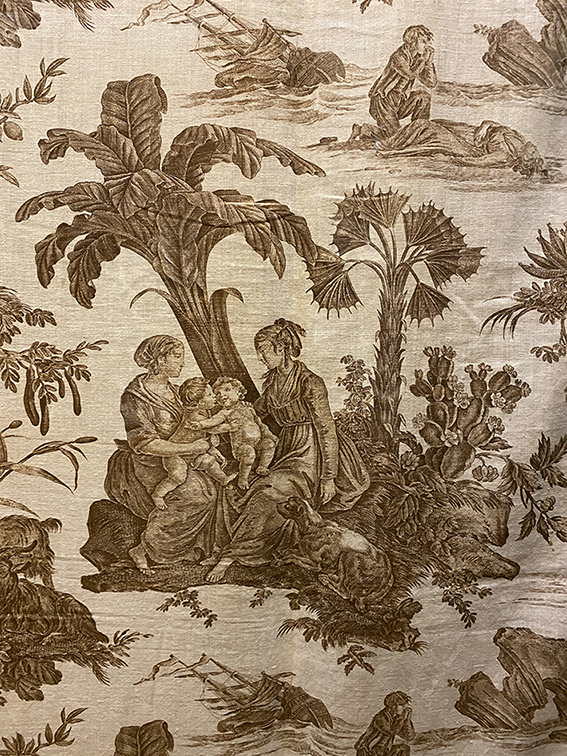
Often referred to simply as ”toile,” toile de Jouy is now considered a symbol of French textile expertise. However, its history has its roots in Indian cotton fabrics, which, from the 17th century onwards, fascinated Europe with their bright colors and delicate patterns.
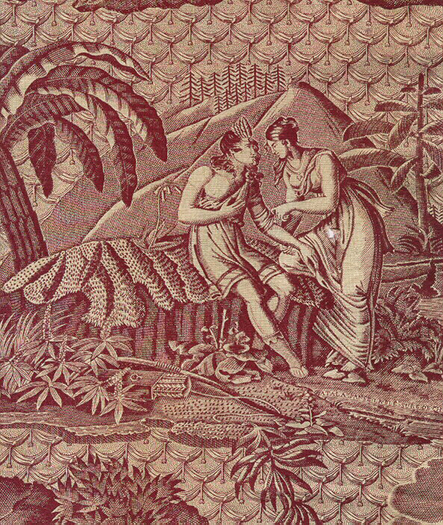
Rouen/Musée de la Toile de Jouy, inv. 983.33.5. a-b.
The history of Indian cotton fabrics remains surprising and little known. Introduced to France through the port of Marseille, they arrived as simple packaging material for goods from the East, before being repurposed by elegant women who turned them into sought-after clothing. Lightweight, affordable, and durable, these cotton fabrics quickly conquered all levels of society and launched a veritable revolution in the art of textiles.
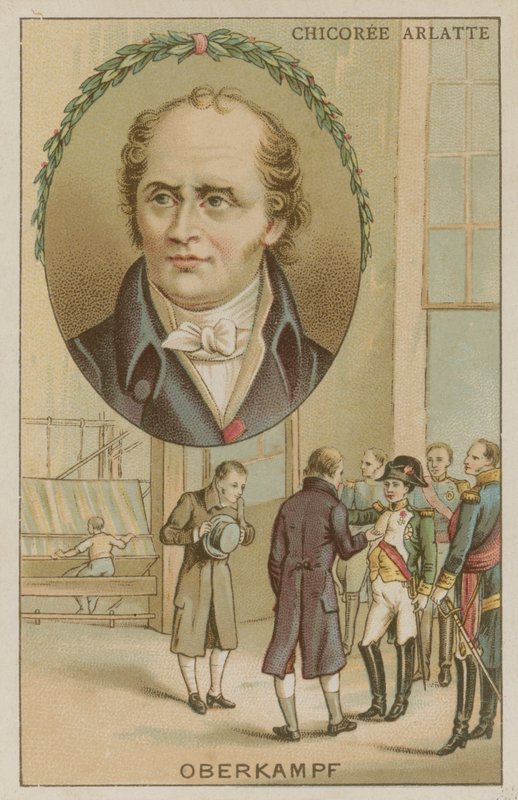
Their success was such that in 1686, Louis XIV banned their use, with Colbert seeking to protect local production. Imported and distributed by the East India Company, these lightweight, painted or printed fabrics in bright colors were accused of competing with French manufacturers and even became, through their popularity, a symbol of defiance against royal power. But their appeal remained, and when the ban was lifted in 1759, Christophe-Philippe Oberkampf, an industrialist of German origin, settled in Jouy-en-Josas, near Versailles. In 1760, he founded a factory there, ideally located on the banks of the Bièvre River, whose pure water was used to wash and dye the fabrics.
A visionary, Oberkampf perfected the printing process by adopting engraved copper plates, capable of accurately reproducing narrative scenes on cotton. Red, blue, or black on a white background, these pastoral, mythological, or contemporary compositions were hugely successful. By the 1770s, the fabric had become a mass-produced product and a marker of refinement. At its peak, the factory employed more than 1,300 workers and was known throughout Europe. Although production ceased in 1843, Toile de Jouy remains in the collective imagination as the embodiment of a textile art that is both universal and deeply French.
Click here to read the full article on Luxus Magazine
Featured photo: © Koziel