






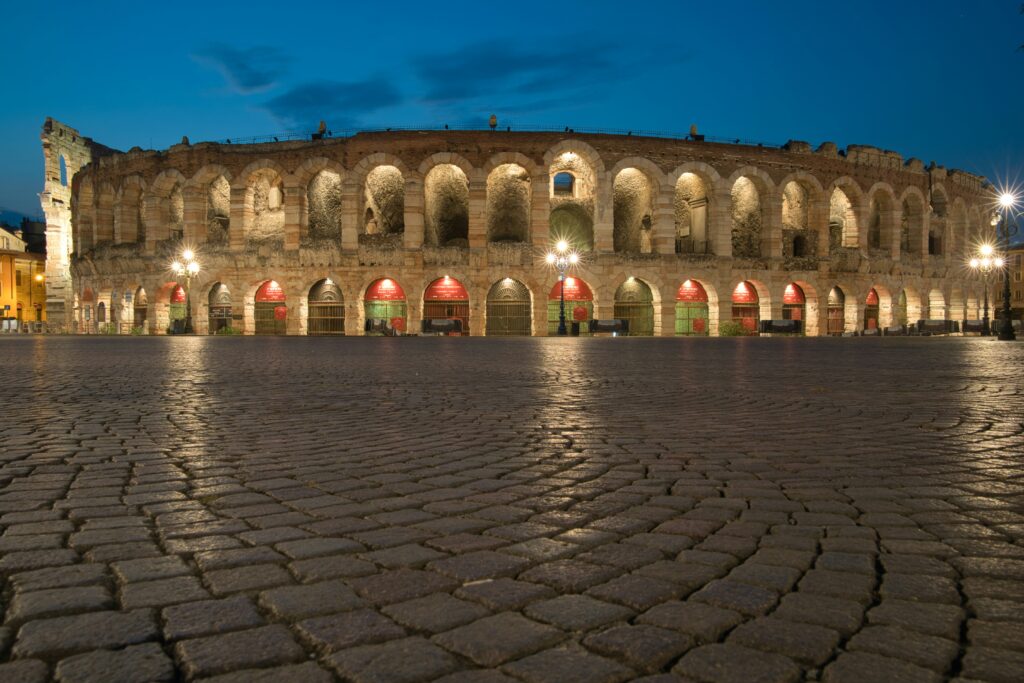
Milano Cortina 2026 will be remembered as the first Winter Olympics to feature venues spread across three different regions. This uniqueness continued with the closing ceremony, which also broke new ground by taking place in a historic venue, namely the Verona Arena. The city of Romeo and Juliet thus became the city of love… and opera.
From Milan to Verona, it’s just a stone’s throw… or rather a region.
While the former is the capital of Lombardy, the latter, associated worldwide with Romeo and Juliet, is the capital of Veneto. It is also a magnet for fans of popular opera, with the Arena Di Verona festival held there every year since 1913, from mid-June to early September.
Despite the distance (105 miles) between them, the two cities saw their hearts beat as one on Sunday, February 22, 2026, that of opera lovers and Shakespeare’s star-crossed lovers.
During the closing ceremony of the Milano Cortina Winter Olympics, the love of both was combined with a spectacle worthy of La Scala, featuring its mythical characters, all introduced by Rigoletto, the tragic jester from Giuseppe Verdi’s eponymous opera.
An ancient site dating back to the 1st century
Long before the tragic passion of its 16th-century lovers, Verona was a Roman province, renowned in particular for its ancient amphitheater. Built in 30 AD, it could accommodate nearly 30,000 spectators.
This Roman arena, one of the best preserved in Italy, welcomes up to 20,000 spectators on the evenings of the Arena Di Verona festival, a mecca for transalpine opera.
The Verona Arena gained its operatic reputation in 1822 with the performance of Rossini’s lyrical prelude before its first opera season in 1856. But it was not until August 10, 1913, on the occasion of the centenary of Giuseppe Verdi’s birth, that the festival really took off. In 1947, Maria Callas even performed Amilcare Ponchielli’s La Gioconda.
Click here to read the full article on Luxus Magazine
Featured photo: © Fondazione Milano Cortina 2026